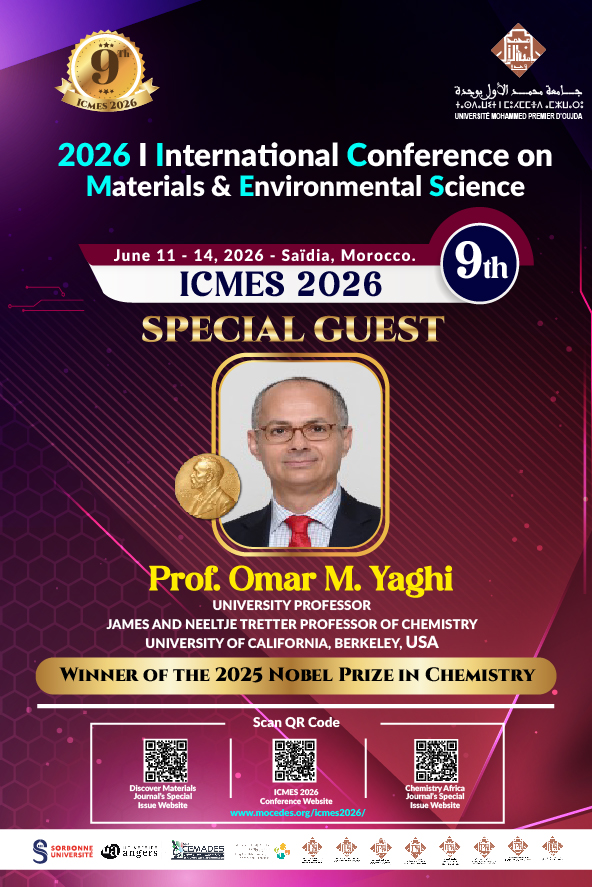
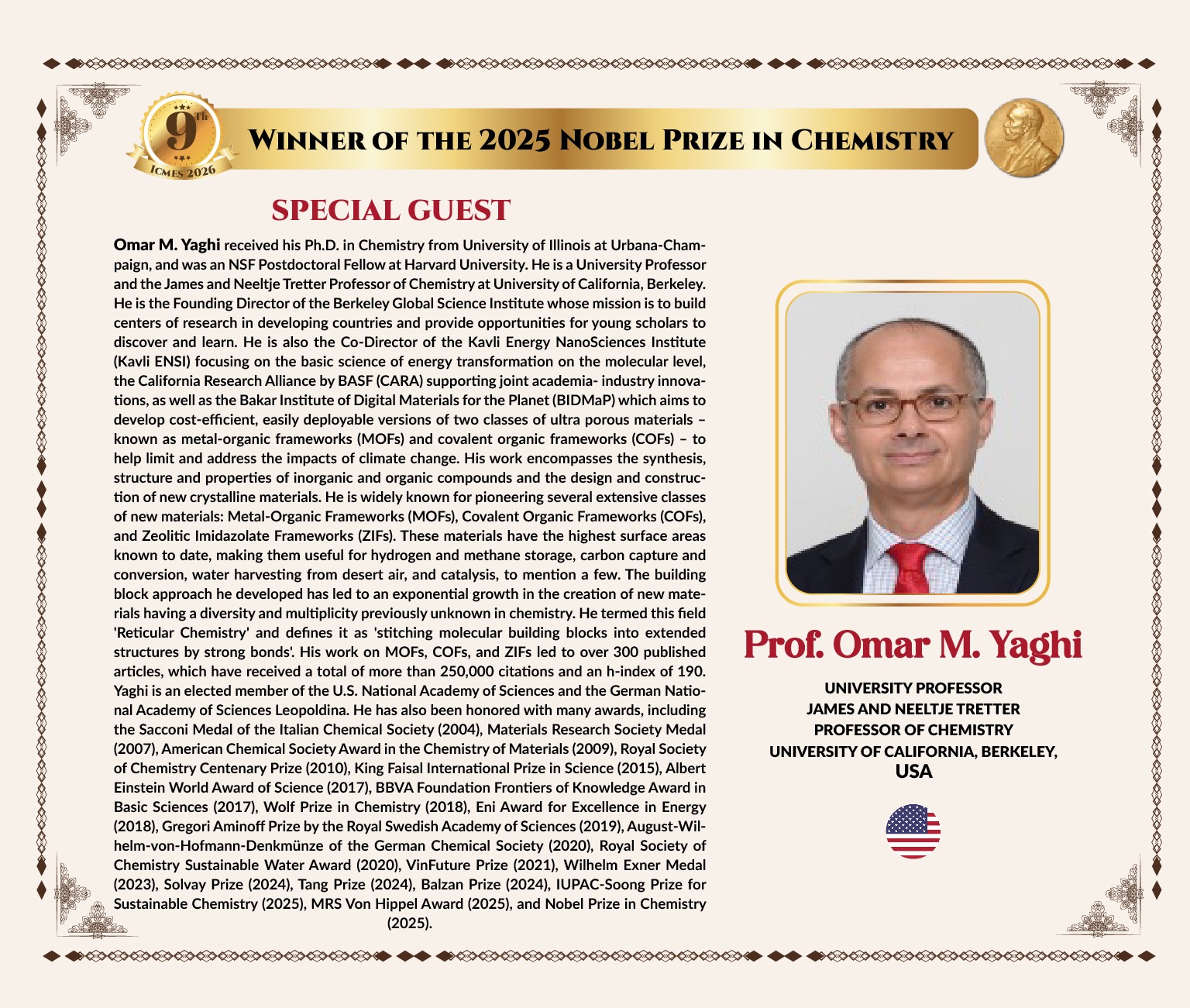
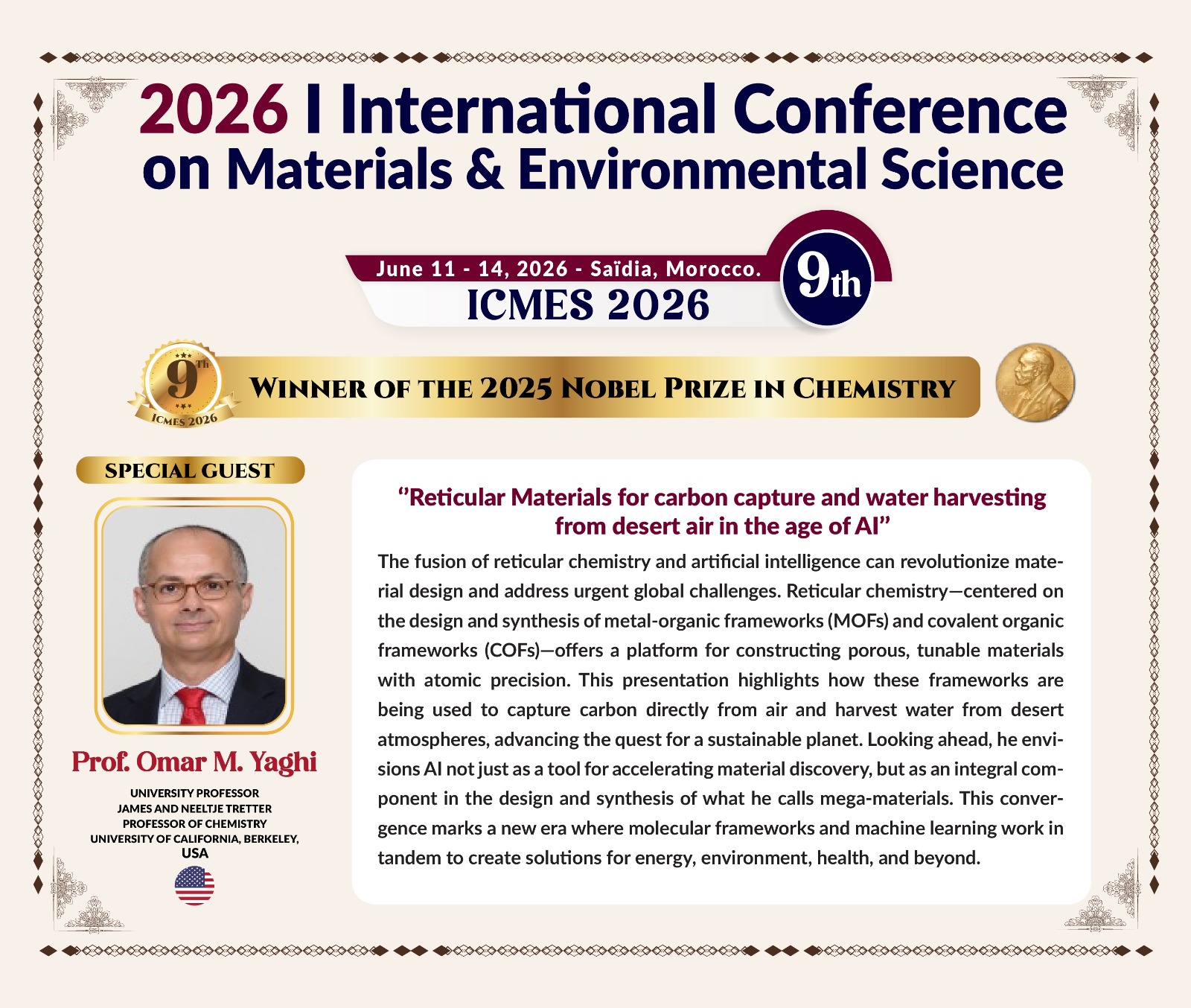
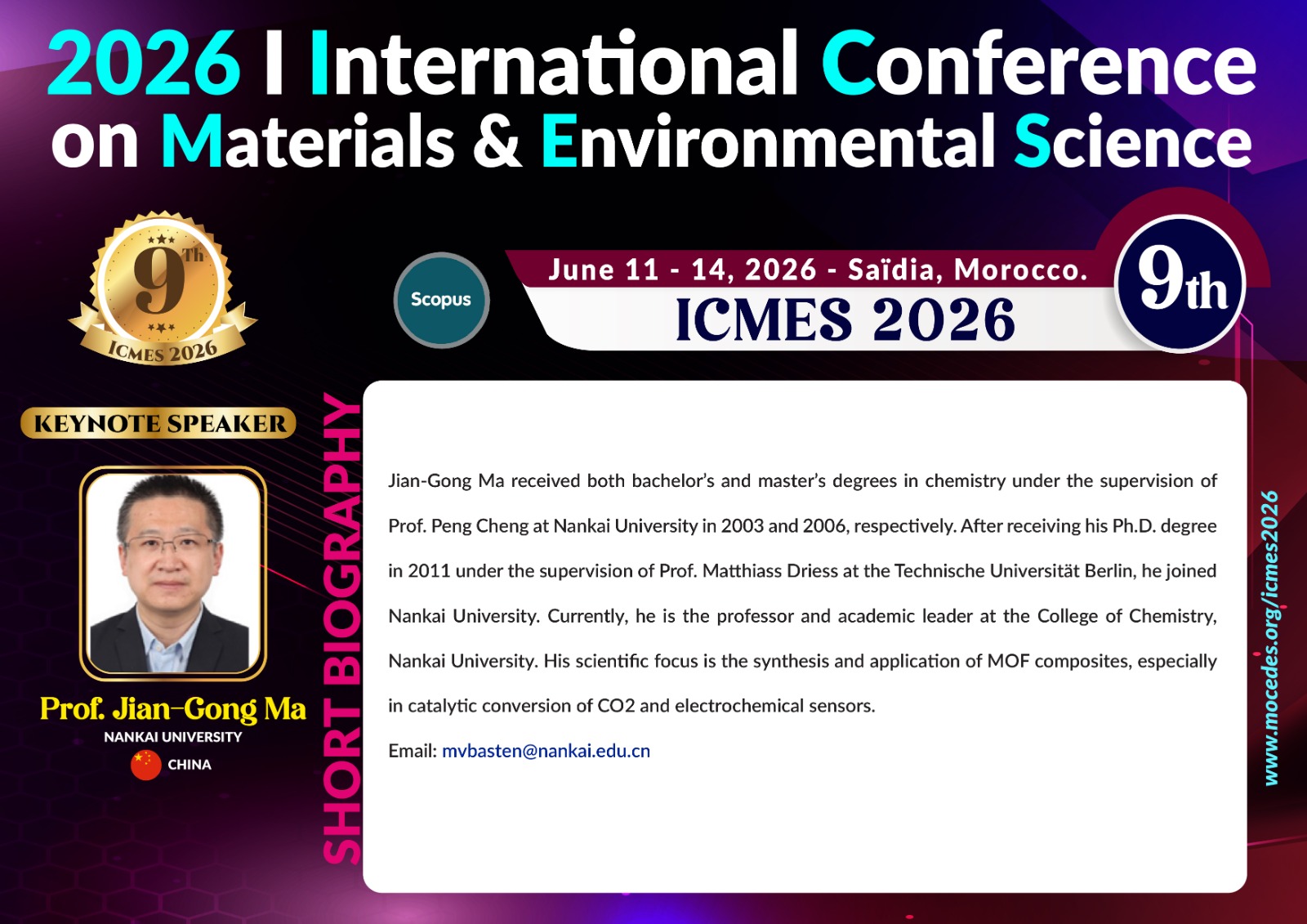
9th International Conference on Materials and Environmental Science.         June 11 - 14, 2026, Saïdia, Morocco.

Welcome to icmes 2026

Dear Colleagues and Friends,

Mohammed First University Oujda - Morocco, Faculty of Sciences in Oujda, King Abdullah University of Science and Technology (KAUST) - SAUDI ARABIA, and University of Angers(LPhiA Laboratory) - France organize in collaboration with CEMADES Association, the 9th International Conference on Materials and Environmental Science - ICMES 2026, under the theme: "Innovations in Water and Energy Technologies, and Materials Science for Climate Resilience and Sustainability". For more than 10 years, ICMES has served as an international stage for dissemination of current and emerging materials, environmental science and Health. Will take place from June 11 - 14, 2026, Saïdia, Morocco.

ICMES will gather experts and scholars from around the world and promote international academic exchange and cooperation. We eagerly anticipate your participation and look forward to welcoming you to an unforgettable conference.

Since its inception in 2016, ICMES has established itself as a high-level international conference, bringing together distinguished scholars, world-class researchers, and leading experts from around the globe. The previous editions were held in 2016 (1st), 2018 (2nd), 2019 (3rd), 2020 (4th), 2022 (5th), 2023 (6th), 2024 (7th), and 2025 (8th), consistently attracting a global audience and providing an elite platform for scientific exchange.

The purpose of ICMES 2026 is to provide a forum to share the most important and latest developments in the field of materials, energy development, environmental science and Health, to exchange research ideas and futurs trends, and to explore potential collaboration opportunities in all regions of the world.

It will be a great pleasure and privilege to meet you in Saïdia, to celebrate science, innovation, and international cooperation in such a vibrant setting.

Indexed by
Scopus
Call for Papers – Special Issue – ICMES 2026
Scopus Scopus
Please click on the image

Our Objectives

In a world increasingly shaped by the urgent challenges of sustainability and innovation, Materials and Energy stand as master keys to unlocking solutions for our planet's future. In response to this pressing global call, 9th ICMES'26, organized by Mohammed First University in collaboration with its esteemed national and international partners, emerges as an international meeting point for cutting-edge research, bringing together academic researchers, industry professionals, and experts across disciplines to explore new frontiers at the intersection of materials science and energy applications.

ICMES'26 will feature a series of high-level Keynote Lectures and Thematic Symposium Sessions, focusing on a diverse range of topics at the forefront of materials and energy research. These include eco-materials and sustainable construction techniques, ferroic superlattice materials, advanced high-performance material coatings, energy conversion and storage technologies, valorisation of residual biomass for energy recovery, as well as simulation challenges in industrial fluid flows and thermosolutal transfer.

This multidisciplinary conference encourages the convergence of scientific observation and engineering innovation, where the scientist observes, understands, quantifies, and predicts, while the engineer transforms, creates, and applies. This dynamic interplay continues to drive the evolution of modern science, bridging disciplines like Mathematics, Mechanics, Chemistry, and Physics.

The ICMES Conference Series on Materials, Energy and Environmental Science proudly supports young researchers, offering them both visibility and opportunities for professional growth. One of the major highlights of ICMES'26 will be the Topical School, which, like in previous editions, will offer exclusive sessions led by internationally renowned speakers that encourage dialogue, mentorship, and the transfer of advanced knowledge.

We look forward to welcoming you to ICMES'26 in Saïdia, Morocco, and to engaging together in building a smarter, more sustainable future.

Proceedings & Program ICMES 2026
General ProgramDownload
Detailed ProgramDownload
ProceedingsDownload

HISTORY OF KEYNOTE SPEAKERS AT ICMES

SELECTED PAPERS PUBLISHED AND AWARDED

+350
Participants

+30
Speakers

+3
Panels

+5
Schools

June 11-14,
2026

Saïdia
Morocco

committee

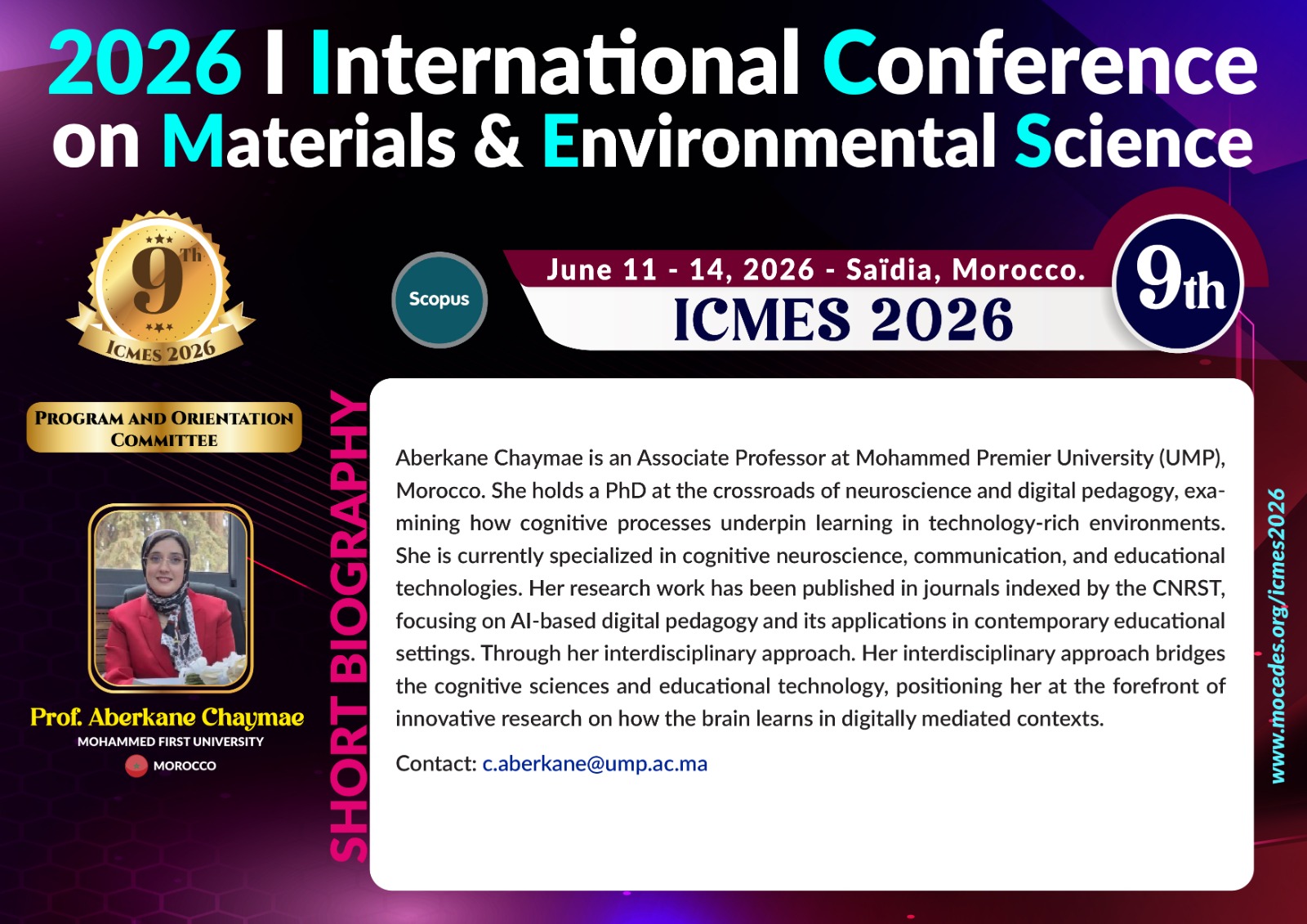
Prof. Faouaz Jeffali

Short biography

Mohammed First University
Oujda – Morocco

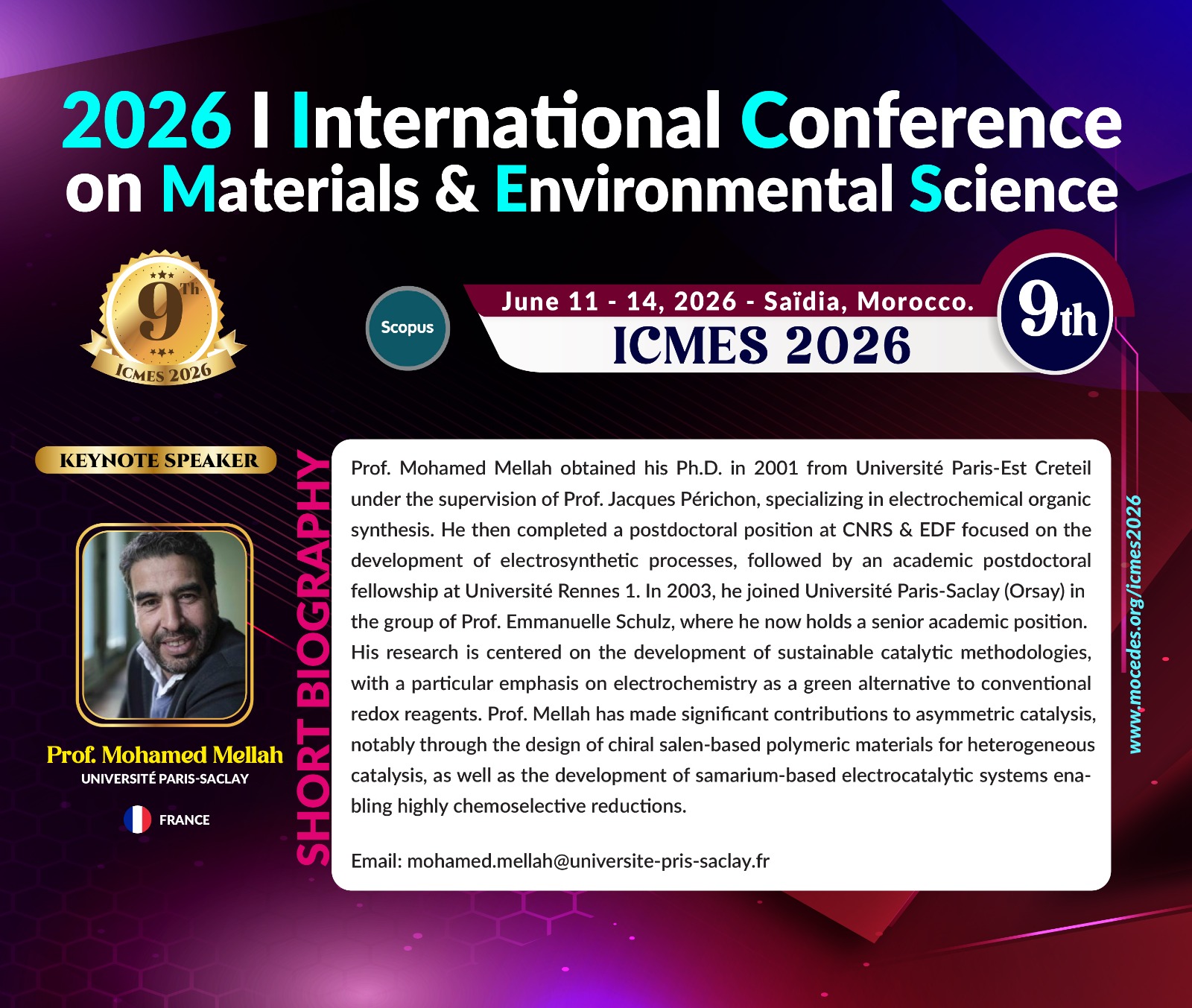
Prof. Mohamed Eddaoudi

Short biography

University of KAUST
Saudi Arabia

Prof. Belkheir Hammouti

Short biography

Euromed University
FES – Morocco

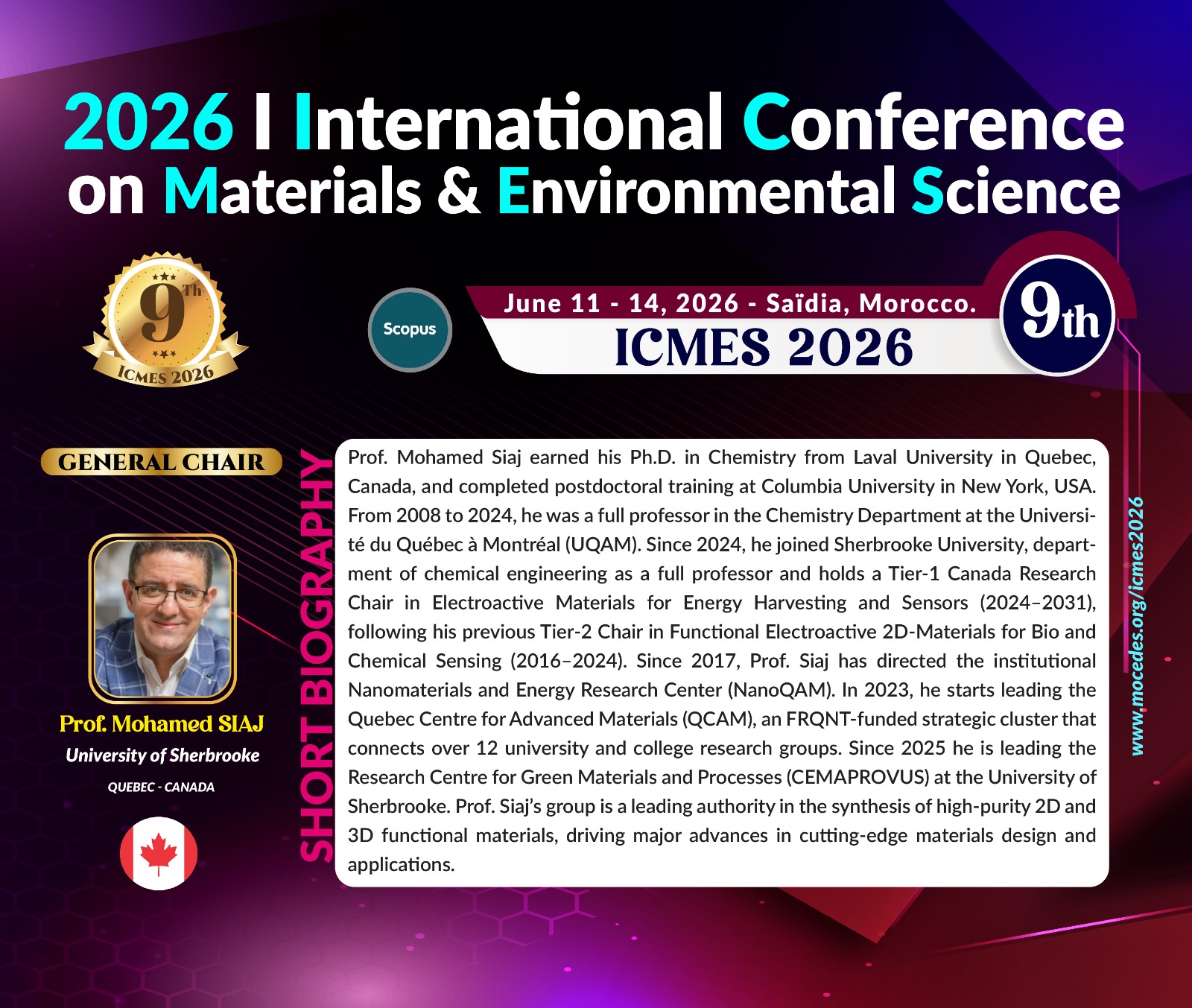
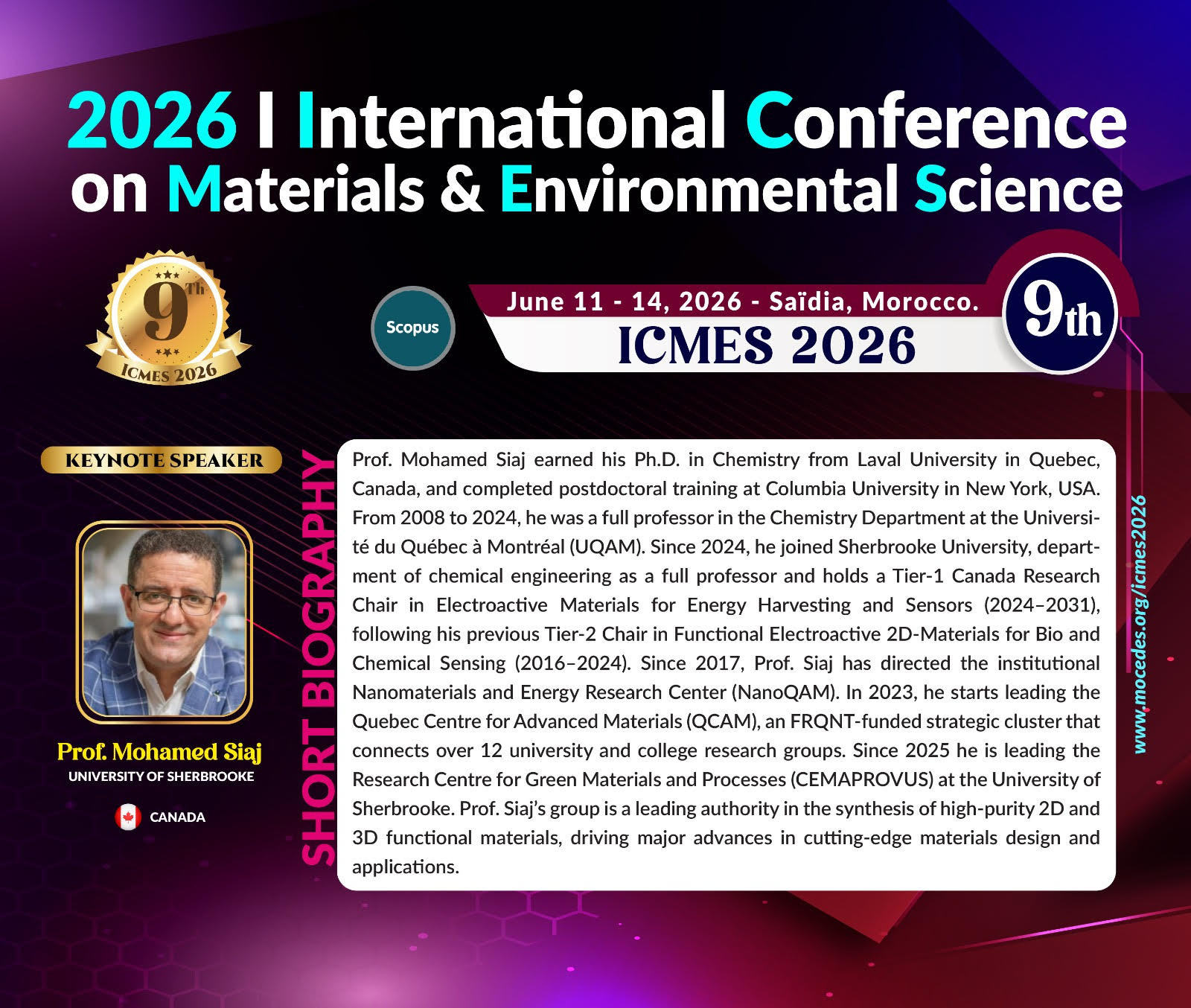
Prof. Mohamed Siaj

Short biography

University of Sherbrooke
Canada

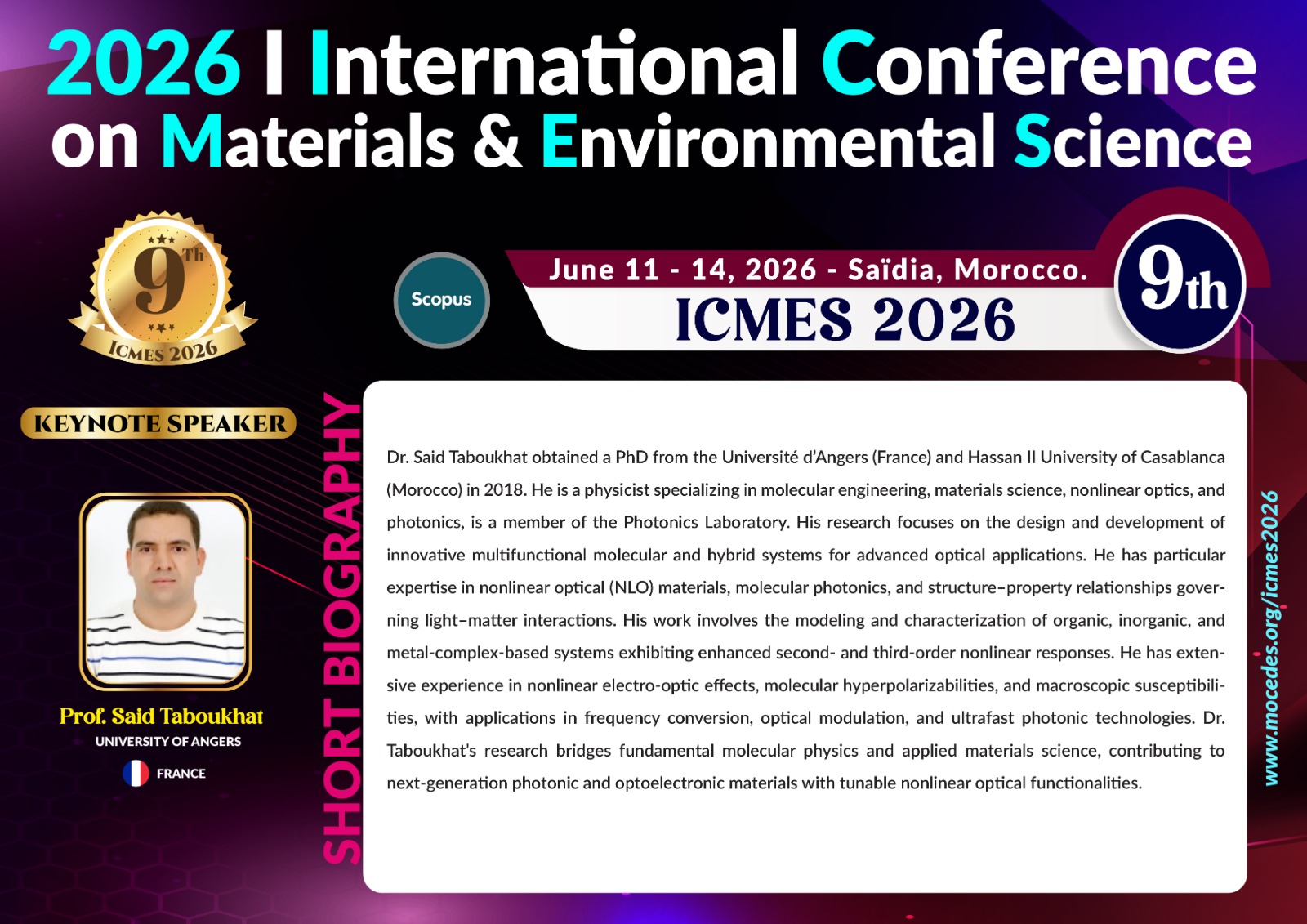
Pr. Bouchta Sahraoui

Prof. Bouchta Sahraoui

Short biography
University of Angers

France

Prof. Rachid Touzani
Short biography

Mohammed First University
Morocco

Jamal Moussa
Prof. Jamal Moussa
Short Biography

University of Sorbonne
France

Prof. Abdelouahad Aouinti
Short biography
Mohammed First University
Morocco
Charafeddine JAMA
Prof. Charafeddine Jama
Short Biography

University of Lille
France

Pr. Mohcine KODAD
Prof. Mohcine Kodad
CHAIR
Short biography
Mohammed First University
Morocco
Pr. Ossama EL ABOUTI
Prof. Ossama El Abouti
MEMBER
Short biography
Abdelmalek Essaadi University
Morocco
Pr. Mohcine KODAD
Prof. Mohcine Kodad
Short biography
Mohammed First University
Morocco
Mircea A. Mateescu
Prof. Mircea A. Mateescu
Short biography
University of Québec
Canada
Mama EL GHAZI
Prof. Mama El Rhazi
Short biography
University Hassan II - Casablanca
Morocco
Fiorenzo Vetrone
Prof. Fiorenzo Vetrone
Short biography
INRS, University of Québec
Canada
Zineb KASSAB
Prof. Zineb KASSAB
Short biography
Mohammed VI Polytechnic University

Morocco

RAFIK NACCACHE
Prof. Rafik Naccache
Short biography
University of Concordia
Canada
Jamal Bouchnaif
Prof. Jamal Bouchnaif
Short biography
Mohammed First University
Morocco
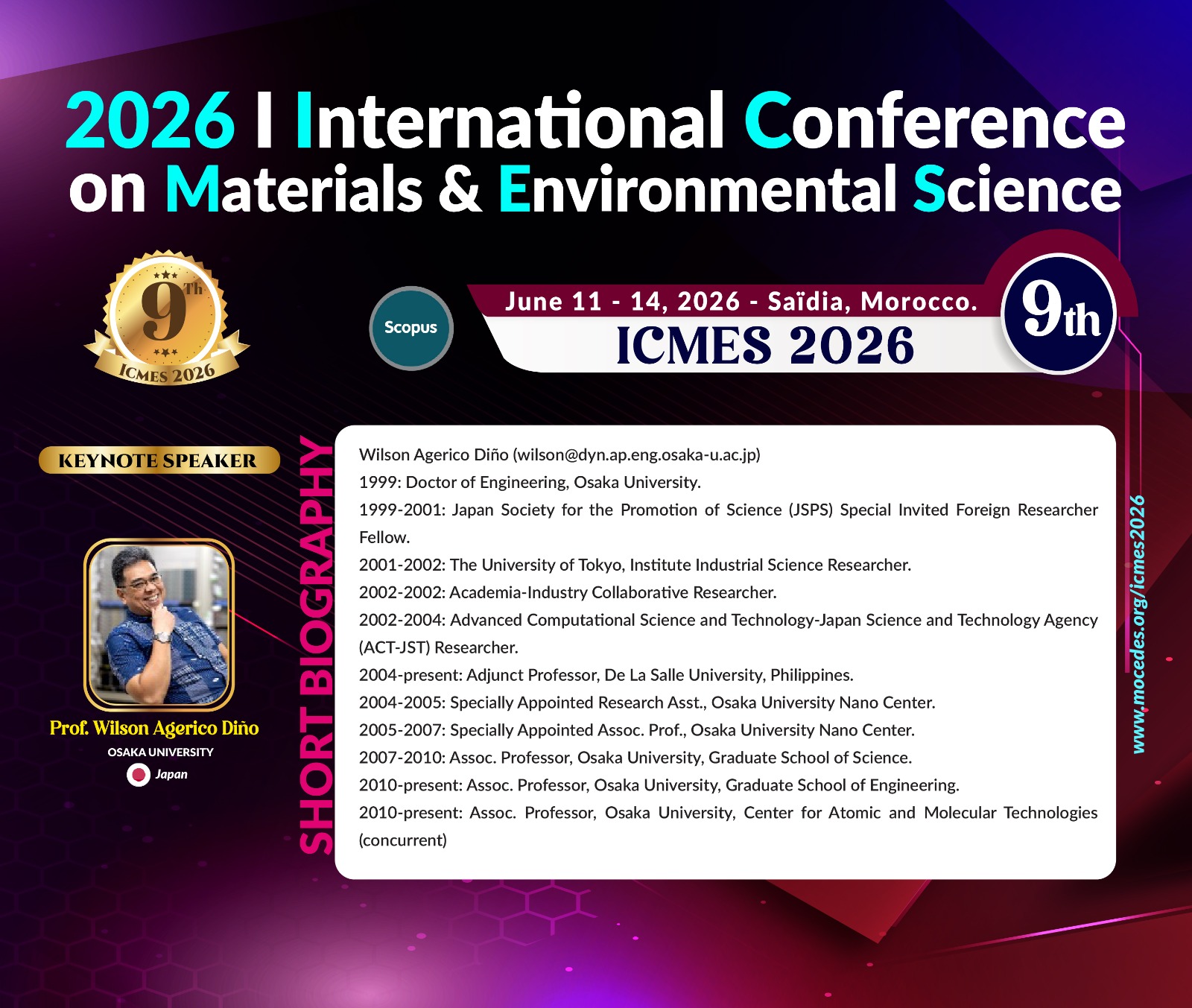
Wilson Aggerico Diño
Prof. Wilson Aggerico Diño
Short biography
Osaka University
JAPAN

Mohamed ABOU-SALAMA
Prof. Mohamed Abou-Salama
Short biography
Mohammed First University

Morocco

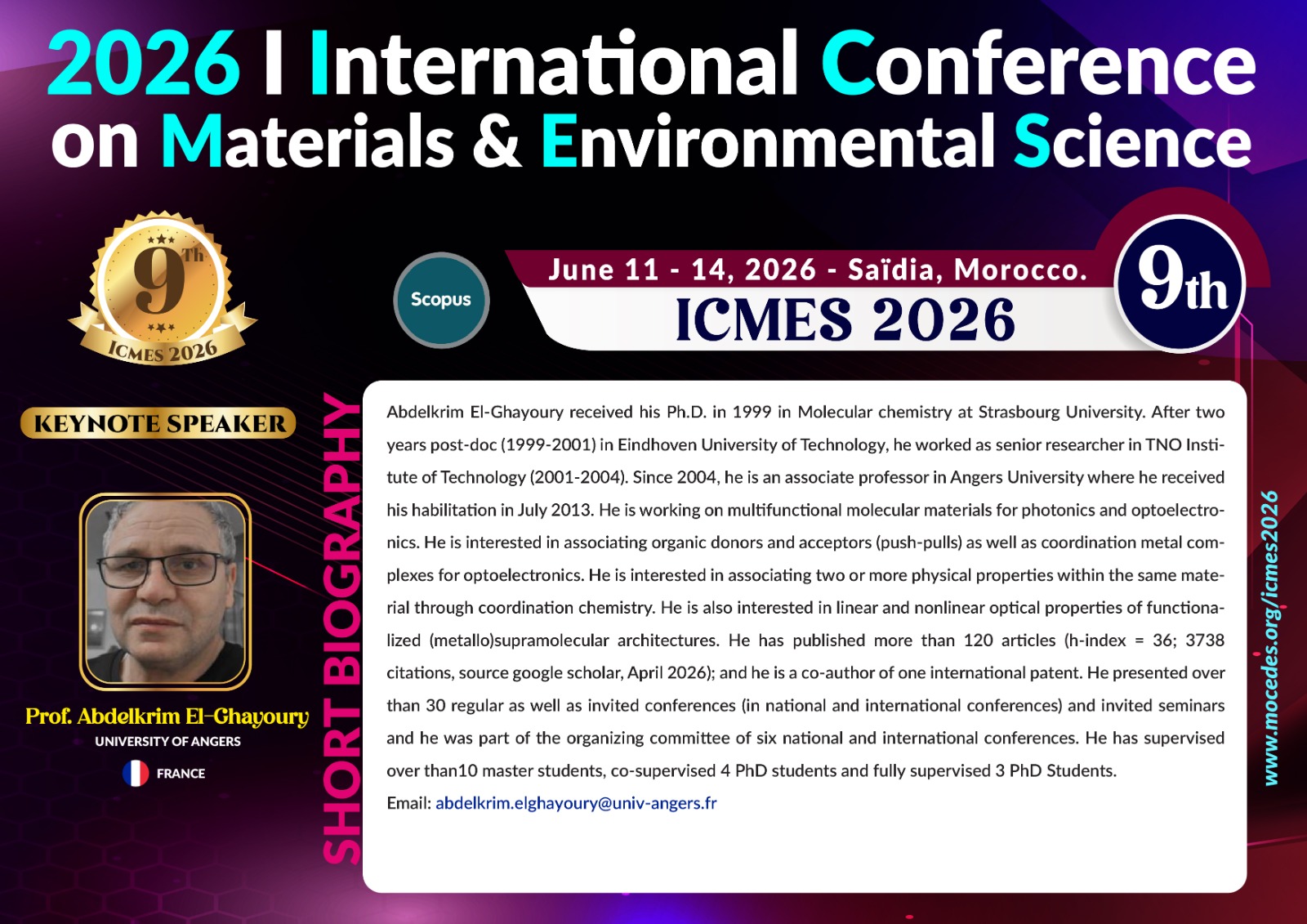
Abdelkrim El-Ghayoury
Prof. Abdelkrim El-Ghayoury
Short biography
University of Angers

France

Noureddine Abidi
Prof. Noureddine Abidi
Short biography
Texas Tech University

USA

Alberto Vomiero
Prof. Alberto Vomiero
Short biography
Luleå University of Technology

Sweden

  • Prof. EDDAOUDI MOHAMED, King Abdullah University of Science and Technology (KAUST), Saudi Arabia.
  • Prof. HAMMOUTI BELKHEIR, Euromed University of Fez, Morocco
  • Prof. SIAJ MOHAMED, University of Sherbrooke, Quebec, Canada
  • Prof. SAHRAOUI BOUCHTA, Photonics Laboratory (LPhiA), SFR MATRIX, University of Angers, France
  • Prof. CHIHAYA ADACHI, Center for Organic Photonics and Electronics Research (OPERA), Kyushu University Motooka, Nishi, Fukuoka, Japan
  • Prof. CHAKER MOHAMED, National Institute of Scientific Research (INRS), Varennes, Quebec, Canada
  • Prof. JACQUES HUOT, Hydrogen Research Institute, University of Quebec at Trois-Rivières, Trois-Rivières, Canada
  • Prof. TOUZANI RACHID, Faculty of Science, Oujda, Morocco
  • Prof. FIORENZO VETRONE, National Institute of Scientific Research (INRS), Varennes, Quebec, Canada
  • Prof. ABOUSALAMA MOMAMMED, Polydisciplinary Faculty, Nador, Morocco
  • Prof. ALBERTO VOMIERO, Luleå University of Technology, Sweden
  • Prof. MAAROUF EL BEKKAYE, Faculty of Science, Oujda, Morocco
  • Prof. GUILLAUME MAURIN, ICGM, University Montpellier, CNRS, ENSCM, Montpellier, France
  • Prof. AOUINTI ABDELOUAHAD, Faculty of Science, Oujda, Morocco
  • Prof. ABIDI NOUREDDINE, Fiber and Biopolymer Research Institute, Texas Tech University, Lubbock, Texas, USA
  • Prof. ALSHAHATEET SOLHE, Department of Chemistry, Mutah University, Jordan
  • Prof. KASSMI KHALIL, Faculty of Science, Oujda, Morocco
  • Prof. WILSON AGGERICO DIÑO, Osaka University, Suita, Japan
  • Prof. NACCACHE RAFIK, Department of Chemistry and Biochemistry, Centre for NanoScience Research, Concordia University, Montreal, Quebec, Canada
  • Prof. CHARAFEDDINE JAMA, University of Science and Technology of Lille, France
  • Prof. KHEIREDDINE AROUA MOHAMED, King Fahd University of Petroleum and Minerals (KFUPM), Saudi Arabia
  • Prof. BRIA DRISS, Faculty of Science, Oujda, Morocco
  • Prof. CHATOUANI AHMED, Regional Centre for Education and Training Professions, Oujda, Morocco
  • Prof. EBNTOUHAMI MOHAMMED, Ibn Tofaïl University, Kenitra, Morocco
  • Prof. EL RHAZI MAMA, University Hassan II of Casablanca, Morocco
  • Prof. SOULAYMANI ABDELMAJID, Ibn Tofaïl University, Kenitra, Morocco
  • Prof. LGAZ HASSANE, Hanyang University, South Korea
  • Prof. EL ABOUTI OSSAMA, Faculty of Sciences and Techniques of Al Hoceima, Morocco
  • Prof. MESSALI MOUSLIM, Faculty of Science, Taibah University, Almadinah Almonawarah, Saudi Arabia
  • Prof. ZAHBOUNE HASSANE, Higher School of Technology of Oujda (UMP), Morocco
  • Prof. BENKADDOUR RACHID, Higher School of Technology (UMP), Morocco
  • Prof. KODAD MOHCINE, Higher School of Technology (UMP), Morocco
  • Prof. EL HANKARI SAMIR, Mohammed VI Polytechnic University, Ben Guerir, Morocco
  • Prof. LAHCEN ZOUHRI, Institut Polytechnique UniLaSalle Beauvais, France
  • Prof. JOSE LUIS GUIL-GUERRERO, Food Technology Division, University of Almería, Spain
  • Prof. NATHALIE TUFENKJI, Department of Chemical Engineering, McGill University, Montreal, Quebec, Canada
  • Prof. RADI SAMAIL, Faculty of Science, Oujda, Morocco
  • Prof. BOUKHEDDADEN KAMEL, Université Paris-Saclay, GEMAC, UMR CNRS, Versailles, France
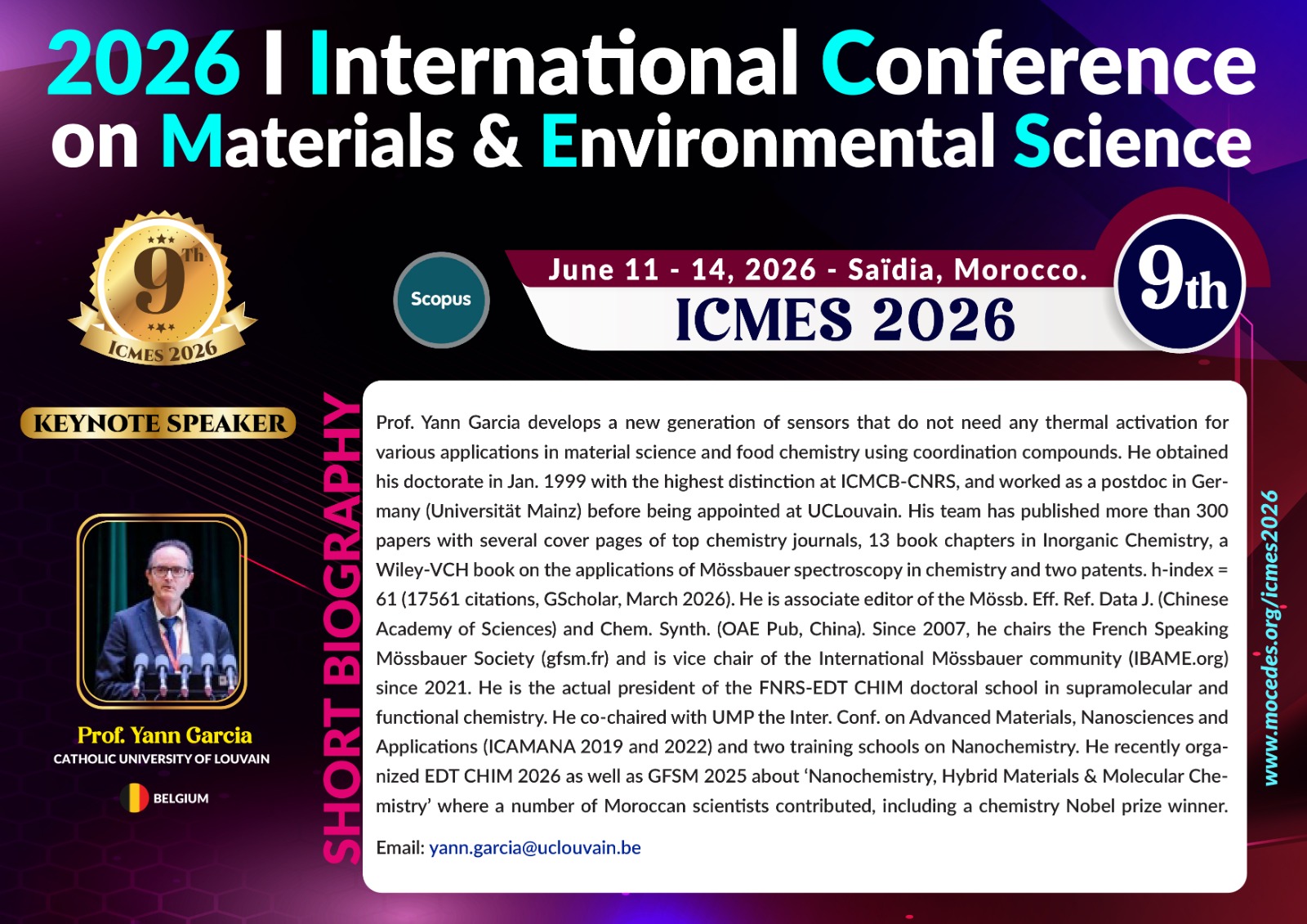
  • Prof. YANN GARCIA, Institute of Condensed Matter and Nanosciences (IMCN/MOST), UCLouvain, Belgium
  • Prof. TADEUSZ SZUMIATA, University of Technology and Humanities in Radom, Poland
  • Prof. HABOUBI KHADIJA, National School of Applied Sciences, Al Hoceima, Morocco
  • Prof. BOUCHNAIF JAMAL, Higher School of Technology of Oujda (UMP), Morocco
  • Prof. ZIANI ELMOSTAFA, Higher School of Technology of Oujda (UMP), Morocco
  • Prof. EL BARKANY ABDELLAH, Sidi Mohammed Ben Abdellah University, Fez, Morocco
  • Prof. CHELGHOUM LOUNES, Paris-Est University – Créteil Val de Marne, Paris, France
  • Prof. FALYOUNI FARID, Faculty of Science, Oujda, Morocco
  • Prof. EL ASSAOUI NAIMA, Faculty of Science, Rabat, Morocco
  • Prof. LRHOUL HANAE, Mohammed V University, Rabat, Morocco
  • Prof. KASSMI KAMAL, Higher School of Technology of Oujda (UMP), Morocco
  • Prof. KASSAB ZINEB, Mohammed VI Polytechnic University, Ben Guerir, Morocco
  • Prof. GIOVANNI FANCHINI, Department of Physics & Astronomy and Chemistry, Western University, London, Ontario, Canada
  • Prof. CHERGUI ABDELHAK, Mohammed V University, Rabat, Morocco
  • Prof. SAVAS KAYA, Sivas Cumhuriyet University, Department of Chemistry, Sivas, Turkey
  • Prof. EL-GHAYOURY ABDELKRIM, University of Angers, France
  • Prof. JAROSLAW MYSLIWIEC, Wroclaw University of Science and Technology, Wroclaw, Poland
  • Prof. HURIYE AKDAS-KILIC, Yildiz Technical University, Turkey
  • Prof. MOUSSA JAMAL, Sorbonne University – Paris Institute of Molecular Chemistry, Paris, France
  • Prof. EMANUELE ORGIU, National Institute of Scientific Research (INRS), Varennes, Quebec, Canada
  • Prof. MIRCEA A. MATEESCU, University of Quebec at Montreal (UQAM), Montreal, Quebec, Canada
  • Prof. MARIA AMPARO F. FAUSTINO, University of Aveiro, Portugal
  • Prof. MARIA DA GRAÇA P. MORGADO S. NEVES, University of Aveiro, Portugal
  • Prof. AMHAMDI HASSAN, Faculty of Sciences and Techniques of Al Hoceima, Morocco
  • Prof. LABJAR NAJOUA, Mohammed V University, Rabat, Morocco
  • Prof. EL OUARGHI HOSSAIN, National School of Applied Sciences, Al Hoceima, Morocco
  • Prof. BOULOUIZ AZIZ, Mohammed First University, Oujda, Morocco
  • Prof. BELFAQUIR MUSTAPHA, Faculty of Science, Kenitra, Morocco
  • Prof. EL HAJJAJI SOUAD, Faculty of Science, Rabat, Morocco
  • Prof. ZOUGGAR SMAIL, Higher School of Technology of Oujda (UMP), Morocco
  • Prof. RICARDO IZQUIERDO, Higher School of Technology, Department of Electrical Engineering, Montréal (Québec), Canada
  • Prof. JEFFALI FAOUAZ, Higher School of Technology of Oujda (UMP), Morocco
  • Prof. GALAI MOUHSINE, Faculty of Science, Kenitra, Morocco
  • Prof. AZZAOUI KHALIL, Faculty of Science, Fez, Morocco
  • Prof. NOUNEH KHALID, Faculty of Science, Kenitra, Morocco
  • Prof. BENHADDOU MOHAMMED, National School of Architecture, Oujda, Morocco
  • Prof. NOUAL ADNANE, Faculty of Science, Oujda, Morocco
  • Prof. EL HASSAN ABBA, Sultan Moulay Slimane University, Beni Mellal, Morocco
  • Prof. Clément Camp, University Claude Bernard, Lyon1, France
  • Prof. Hong Li, Nanyang Technological University, Singapore
  • Prof. Zakaria Halime, Paris-Saclay University, France
  • Prof. Nicolas Illy, University of Sorbonne, France
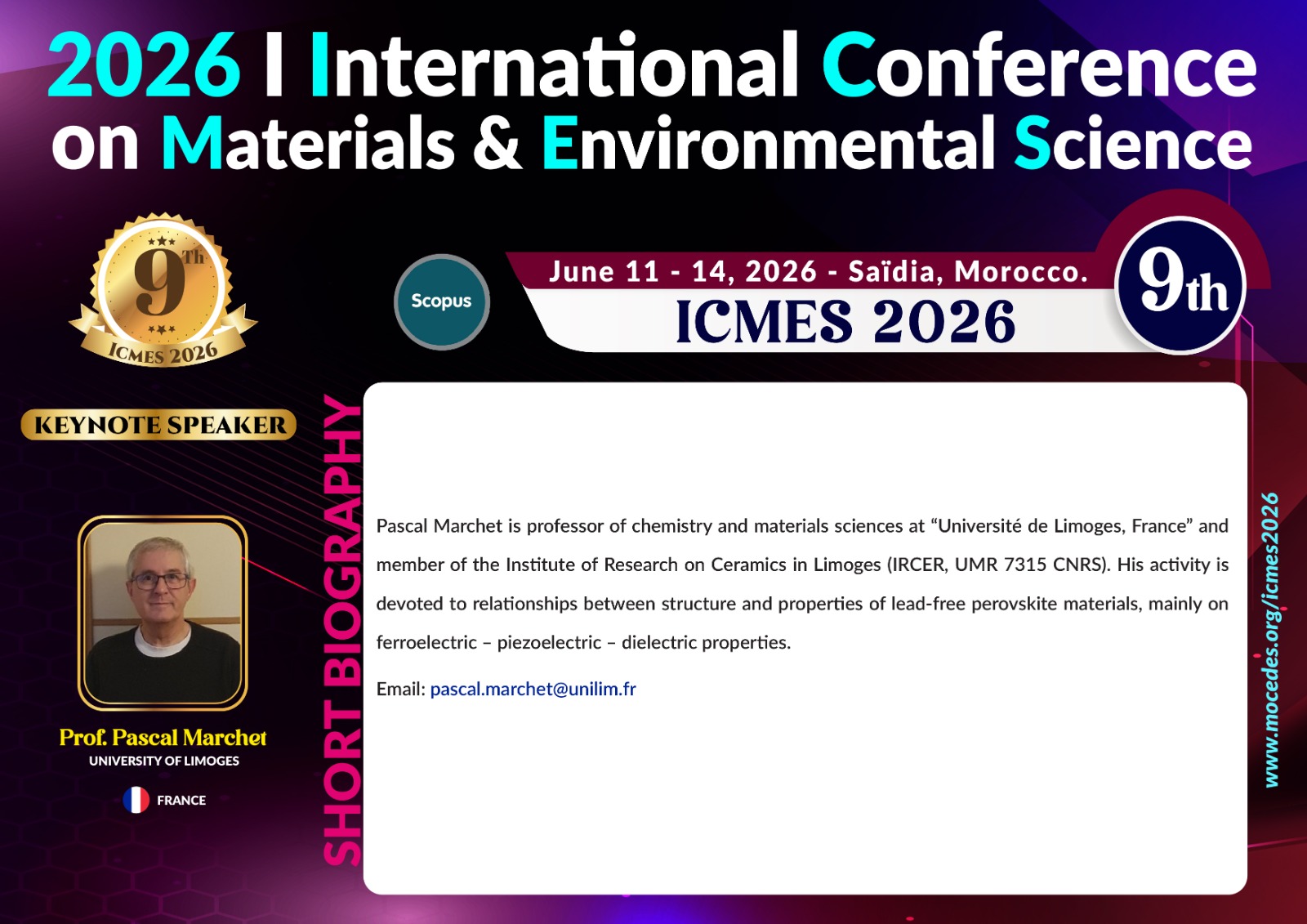
  • Prof. Pascal Marchet, University of Limoges, France
  • Prof. Boumediene Naima, University of Picardy Jules Verne, France
  • Prof. Youichi Tsuchiya, Center for Organic Photonics and Electronics Research (OPERA), Kyushu University, Japan
  • Prof. Ibrahim ABDELLAH, University of Lorraine, France
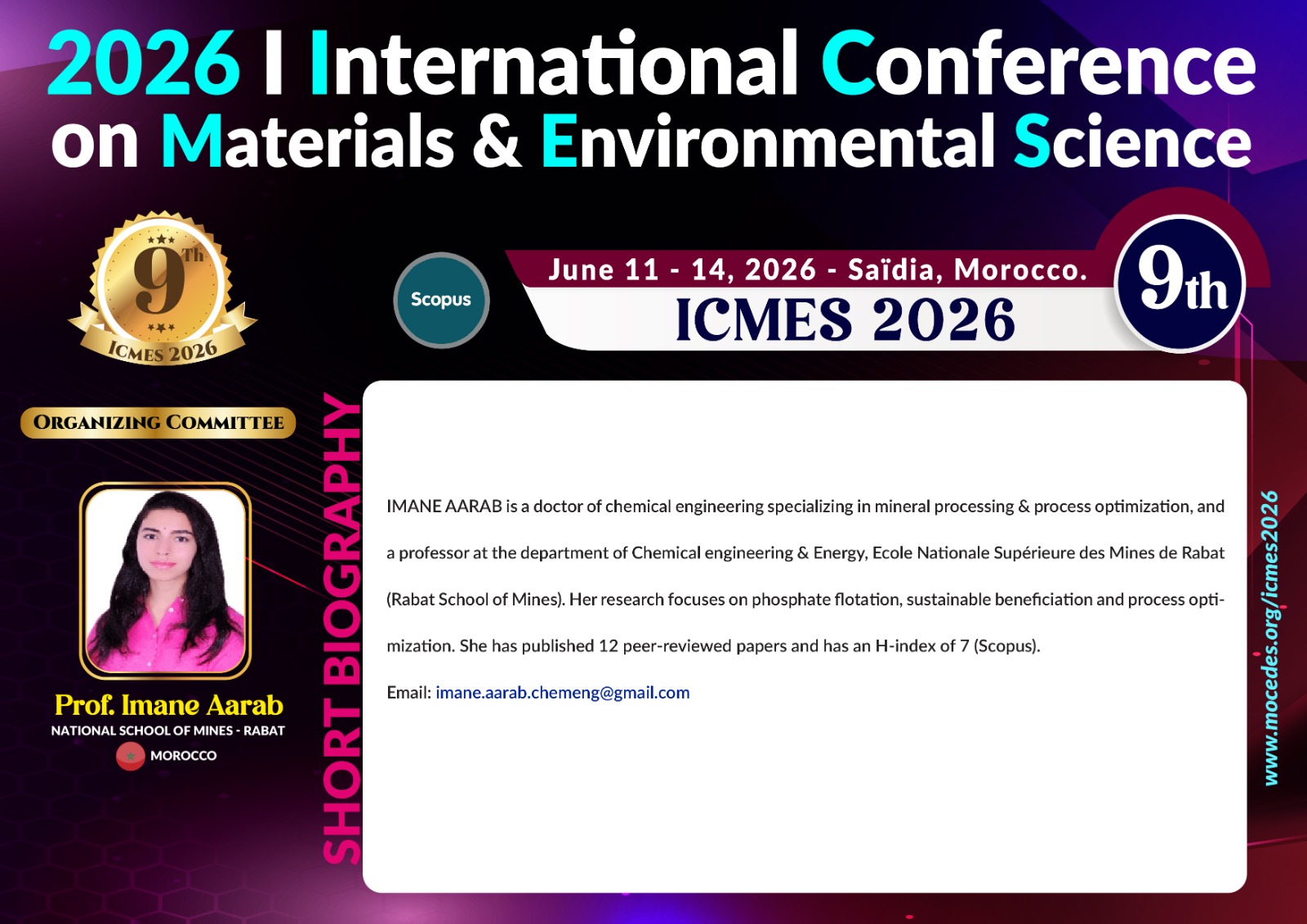
  • Prof. AARAB IMANE, National School of Mines ENSM of Rabat, Morocco
  • Prof. Souhir Boujday, University of Sorbonne, France
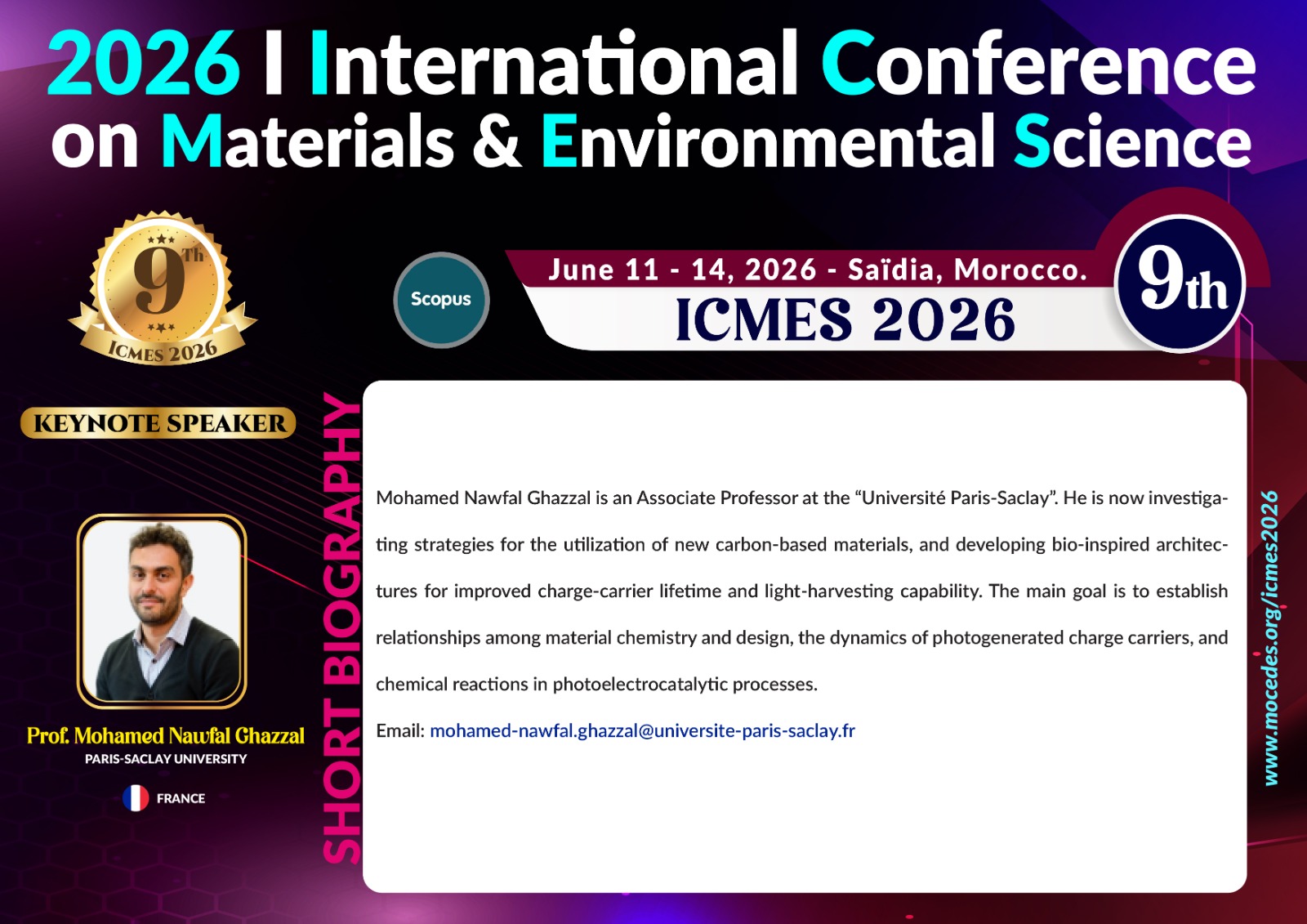
  • Prof. Mohamed Nawfal Ghazzal, Paris-Saclay University, France
  • Prof. Adyl OUSSAID, Polydisciplinary Faculty, Nador, Morocco

Our Keynote Speakers

Prof. Mohamed Eddaoudi

University of KAUST
(Saudi Arabia)
Short biography
Abstract
Prof. Souhir Boujday

Prof. Souhir Boujday

University of Sorbonne
(France)
Short biography
Abstract

Prof. Hong Li

Nanyang Technological University
(Singapore)
Short biography
Abstract
Bouchta SAHRAOUI

Prof. Bouchta Sahraoui

University of Angers
(France)
Short biography
Abstract
Mohamed SIAJ

Prof. Mohamed Siaj

University of Sherbrooke
(Canada)
Short biography
Abstract
Clément Camp

Prof. Clément Camp

University Claude Bernard
(France)
Short Biography
Abstract
Youichi Tsuchiya

Prof. Youichi Tsuchiya

Kyushu University
(Japan)
Short biography
Abstract
Moussa

Prof. Jamal Moussa

University of Sorbonne
(France)
Short Biography
Abstract
Halime

Prof. Zakaria Halime

Paris-Saclay University
(France)
Short Biography
Abstract
Jacques Huot

Prof. Jacques Huot

University of Québec
(Canada)
Short Biography
Abstract
Nicolas Illy

Prof. Nicolas Illy

University of Sorbonne
(France)
Short Biography
Abstract
Wilson Aggerico Diño

Prof. Wilson Aggerico Diño

Osaka University
(Japan)
Short Biography
Abstract

Pascal

Prof. Pascal Marchet

University of Limoges
(France)
Short Biography
Abstract
José L. GUIL-Guerrero

Prof. José L. GUIL-Guerrero

University of Almería
(Spain)
Short Biography
Abstract
Ibrahim Abdellah

Prof. Ibrahim Abdellah

University of Lorraine
(France)
Short Biography
Abstract
Solhe F. Alshahateet

Prof. Solhe F. Alshahateet

Mutah University
(Jordan)
Short Biography
Abstract
Mohamed Nawfal Ghazzal

Prof. Mohamed Nawfal Ghazzal

Paris-Saclay University
(France)
Short Biography
Abstract

Topics

  • Advanced functionalized materials for optoelectronic applications ;
  • Molecular materials for nonlinear optics ;
  • Advanced molecular materials for Thermally Activated Delayed Fluorescence, OLEDs emitters ;
  • Molecular modeling and nonlinear optical properties of organic/inorganic complexes ;
  • Advance organic compounds for photonics and optoelectronic applications ;
  • Advanced materials for lasers and laser applications ;
  • Nanocomposite materials for nonlinear optics ;
  • Materials for Optics and Optoelectronic Devices ;
  • Advanced functional materials for photovoltaic effects ;
  • Photoluminescence of crystals and glasses dedicated to laser systems ;
  • Technology and properties of optical fibers doped with lanthanides ;
  • New active materials and glass-ceramic optical fibers for photonic applications ;
  • Rare-Earth-doped optical materials: synthesis, characterization, and applications to lasers ;
  • Green chemistry and physics for optics nonlinear optical applications ;
  • Advances in the synthesis of polymers ;
  • Catalysis and Chemical Reactions ;
  • Composite and nanocomposite materials ;
  • Fine chemicals ;
  • Biodegradables polymers ;
  • Green chemistry ;
  • Inorganic, hybrid materials and their potential uses ;
  • Interfacial & colloidal phenomena ;
  • Materials, semiconductors ;
  • Micro-hydro- dynamics: Theory and Applications ;
  • Modeling and Simulation in Chemical Engineering ;
  • Nanomaterials and their valorizations ;
  • Organic compounds and their applications ;
  • Theoretical calculations and modeling ;
  • etc...
  • Construction materials ;
  • Electronic, Optical and Magnetic Materials ;
  • Composite materials ;
  • Green Manufacturing and Sustainability ;
  • Recycled materiales ;
  • New construction materials ;
  • New Manufacturing and Sustainability ;
  • Materials : Characterization and Testing ;
  • Biomaterials and Nanobiotechnology ;
  • Nanomaterials in Food, Agriculture and Water ;
  • Nanophotonics and Nanoplasmonics ;
  • Smart grid and circuit ;
  • Photonics and optoelectronics ;
  • Electromagnetic and photonics ;
  • Electro-optical phenomena of semiconductors ;
  • Power electronics and energy systems ;
  • Signal processing ;
  • Techniques of laser and applications Of electro-optics ;
  • Simulation of propagation ;
  • Battery management system ;
  • Computer relaying integrated optics and electro-optics devices ;
  • Robotics and atomization engineering ;
  • Solar power generation ;
  • Photosensitive polymer material and polymer information storage material ;
  • Organic solar cell materials ;
  • Application of new optoelectronic materials ;
  • Machine learning and Nanotechnology ;
  • Analytical chemistry ;
  • Radiation chemistry and radiochemistry ;
  • Electrochemistry ;
  • Modeling and theoretical chemistry ;
  • Nanosciences ;
  • Magnetism and magnetic resonance ;
  • Photochemistry, photophysics, and photosciences ;
  • Optical and neutron spectroscopy ;
  • Advanced Polymer Materials and Nanocomposites ;
  • Graphene Materials.
  • Clean and safe processes ;
  • Conversion and transformation of biomass ;
  • Energy economy or energy generation ;
  • Energy storage & management ;
  • Catalysts/Electrocatalysis/Photocatalysts ;
  • Purification/Separation/Membranes ;
  • Environmental Impact/Emissions ;
  • Fuel cell, biogas ;
  • Heat transfer & Thermal Energy ;
  • Hybrid renewable energy ;
  • MH Batteries/MH Applications ;
  • Materials for batteries and supercapacitors ;
  • Photovoltaics, photocatalysis, and solar fuel production ;
  • Electrochemical reactions and energy conversion ;
  • Energy production, storage, and conversion ;
  • Hydrogen Energy ;
  • Advanced Energy Materials ;
  • Solar Energy Materials ;
  • Development and Utilization of Solar Energy ;
  • Development and Utilization of Biomass Energy ;
  • Development and Utilization of Wind Energy ;
  • Nuclear Energy Engineering ;
  • Hydrogen and Fuel Cell ;
  • Bio-diesel fuels ;
  • Photovoltaic Systems and Solar Energy Engineering ;
  • Wind Energy Generation ;
  • Renewable Energy Grid ;
  • Wind resources environmental impact ;
  • Machines and wind farms ;
  • Hydropower Applications ;
  • Environmental impact assessment ;
  • Photovoltaic Technology ;
  • Solar cell technology ;
  • PV manufacture, testing and certification ;
  • PV for rural development ;
  • Solar Thermal Applications ;
  • Solar thermal electricity ;
  • Geothermal Applications ;
  • Geothermal heating and heat pumps ;
  • Renewable Energy Utilizations ;
  • New Energy Vehicles, Electric Vehicles.
  • Artificial Intelligence ;
  • Biomedical control systems ;
  • High voltage DC transmission ;
  • Linear and nonlinear control systems ;
  • Power electronic & Power Systems ;
  • System identification and control ;
  • Non-destructive diagnostic ;
  • Medical physics simulation ;
  • Simulation of particle interactions with matter ;
  • Nuclear Engineering ;
  • etc...
  • Smart city ;
  • Green city ;
  • Sustainable city ;
  • Net building ;
  • Positive energy building ;
  • Building 4.0 ;
  • Advanced materials and technologies ;
  • Construction techniques between tradition and innovation ;
  • Production and implementation of local materials ;
  • Regulatory and normative references and energy efficiency ;
  • etc...
  • Agricultural Biotechnology regulations and rules ;
  • Agriculture Products and challenges towards the one heath concept ;
  • Bioactive natural Products ;
  • Biocatalysis and organocatalysis ;
  • Biomedical Computational drug discovery ;
  • Control and engineering system for food industry;
  • Ecological Engineering ;
  • Environmental Biotechnology and nanobiotechnology ;
  • Enzyme and Fermentation ;
  • Extraction and valorization of natural products ;
  • Food safety and technology ;
  • etc...
  • Corrosion and protection of metals ;
  • Smart Technologies for Sustainable Water Management ;
  • Development Planning and Policy ;
  • Environment Protection challenges towards today and future ecosystem ;
  • Materials: Production, Applications & Membrane science ;
  • New tools in pesticides detection and analysis ;
  • Solid and liquid waste treatment ;
  • Water management and new technology to face the increase demand wide world ;
  • Ecosystems Management ;
  • Solid Waste Management ;
  • Environmental Management ;
  • Water Resources Management ;
  • Watershed/ River Basin Management ;
  • Wastewater Discharge Management ;
  • Hydrology ;
  • Ground water remediation ;
  • Water resources and river basin management ;
  • Ground water management ;
  • Wastewater and sludge treatment ;
  • Anaerobic treatment ;
  • Process modelling ;
  • Sludge treatment and reuse ;
  • Industrial wastewater treatment ;
  • Water treatment and reclamation ;
  • Management of water treatment residuals ;
  • Reuse of reclaimed waters.
  • Clinical chemistry ;
  • Quality ;
  • Sequencing ;
  • Oncogenetics ;
  • Anatomopathology ;
  • Autoimmunity ;
  • Hemostasis ;
  • Cytology ;
  • etc...

Submission

Terms

  • Authors submitting abstracts are responsible for ensuring that all authors listed on the abstract have been notified of the submission.
  • Each abstract will be reviewed by the 2026 Review Committee, and decisions to accept or reject abstracts rest with this committee.
  • Please ensure all special characters and formatting display correctly.

Modes of Presentation

- A. Oral presentation
- B. Poster presentation

Language

- All abstracts must be written exclusively in English (including the title, abstract text, author names and affiliations).
- All the abstracts shall be submitted as per the attached sample abstract template which consists of the following below mentioned fields.
- Any abstract not in compliance with attached sample template will not be sent to scientific committee for review process until it meets requirement as per the template available online to download.

How to submit your abstract to ICMES2026 ?

Follow our step-by-step guide on how to submit :

  1. Identify which conference theme you would like to submit an abstract for ;
  2. Download the abstract template here ;
  3. Prepare your abstract according to the abstract template ;
  4. Send your abstract by email : icmes2026saidia@ump.ac.ma with Identify which conference topics.

Chemistry Africa Journal

Electronic ISSN: 2522-5766

Scopus

SPECIAL ISSUE CALL FOR PAPERS (2026):

"Innovating Water, Energy and Materials for a Sustainable Future – As Part of a Conference 9th ICMES-2026."

Aim and Scope

This special issue will include selected, peer-reviewed contributions from the 9th International Conference on Materials & Environmental Science (ICMES 2026), held from June 11 to 14, 2026, in Saïdia, Morocco. Contributions originating from this leading international conference are expected to significantly enhance the scientific quality, visibility, and impact of the Special Issue.

https://link.springer.com/collections/iihjjgebfg

The proposed special issue addresses key challenges and opportunities within the fields of environmental sciences, Water Resources Engineering, Chemical Engineering, innovative materials, and green energy, aligning seamlessly with the core themes of the Chemistry Africa Journal. The significance of this topic is underscored by its multidisciplinary nature, bridging physical and chemical perspectives with biotechnology and material science to tackle pressing global issues such as environmental degradation, water scarcity, and sustainable energy solutions.

The scope of the Special Issue will focus on the following disciplines

• Chemical & Energy Systems Engineering;
• Climate Change & Sustainability;
• Materials Science & Engineering;
• Water Resources Engineering.

Submission Details

• Submissions Open: 01 April 2026
• Submission Deadline: 01 October 2026
• Submission Instructions:
The submission option will be activated in the Editorial Manager (EM) system within the coming days. This will allow authors to begin submitting their manuscripts directly under the Special Issue title starting April 01.
(Please consult the journal’s website for complete submission guidelines.)

Further Information

For detailed submission instructions and additional information regarding the Special Issue, please visit the Chemistry Africa Journal.
https://link.springer.com/collections/iihjjgebfg

Journal Discover Materials

Electronic ISSN 2730-7727

Scopus

SPECIAL ISSUE CALL FOR PAPERS (2026):

We invite you to submit your work to the Special Issue of the Journal of Discover Materials (Scopus-indexed), entitled “Advanced Materials for a Sustainable Future: Tackling to Water, Energy and Environmental Challenges” - ICMES-2026.

https://link.springer.com/collections/geegidceah

This collection aims to publish contributions that bridge the gap between theoretical predictions and experimental realizations, with a focus on the following topics:
• Energy Storage Materials;
• Sustainable Energy Technologies;
• Hydrogen Storage Materials;
• Green Chemistry for Sustainable Environmental;
• Advanced Materials for Water Treatment and Purification;
• Nanomaterials and Nanotechnologies for Environmental Applications;
• Green Chemistry for Sustainable Environmental Practices;
• Materials for Optics, Electronics, and Devices;
• Advanced Materials from Organic and Inorganic Devices;
• Materials Physics and Chemistry;
• Green Energy, Renewable, Storage and Sustainable Development;
• Materials for Architectural Heritage ;
• Sustainable Construction Materials ;
• Advanced Materials for CO2 Capture and Conversion;
• Development of Sustainable Materials;
• Biomaterials and Biotechnology for Sustainable Applications.

SUBMISSION DETAILS

Open for submissions
Submission deadline: 04 December 2026
• All submissions must be made via the Journal of Discover Materials online submission platform (Editorial Manager). Click “Submit to this journal.”
During the submission, please use the article type SI: “Advanced Materials for a Sustainable Future: Tackling to Water, Energy and Environmental Challenges” - ICMES-2026

Further Information

For detailed submission instructions and additional information regarding the Special Issue, please visit the Journal Discover Materials.
https://link.springer.com/collections/geegidceah

ICMES 2024 / Volume XX, Part XX, Pages XX-XX (2024)
https://link.springer.com/collections/idabaciibj

Icmes2022 / Volume 72, Part 7, Pages 3229-3942 (2023)
https://www.sciencedirect.com/journal/materials-today-proceedings/vol/72/part/P7

ICMES2020 / Volume 45, Part 8, Pages 7259-7800 (2021)
https://www.sciencedirect.com/journal/materials-today-proceedings/vol/45/part/P8

ICMES2018 / Volume 13, Part 3, Pages 453-1258 (2019)
https://www.sciencedirect.com/journal/materials-today-proceedings/vol/13/part/P3

PRESENTATION AWARDS


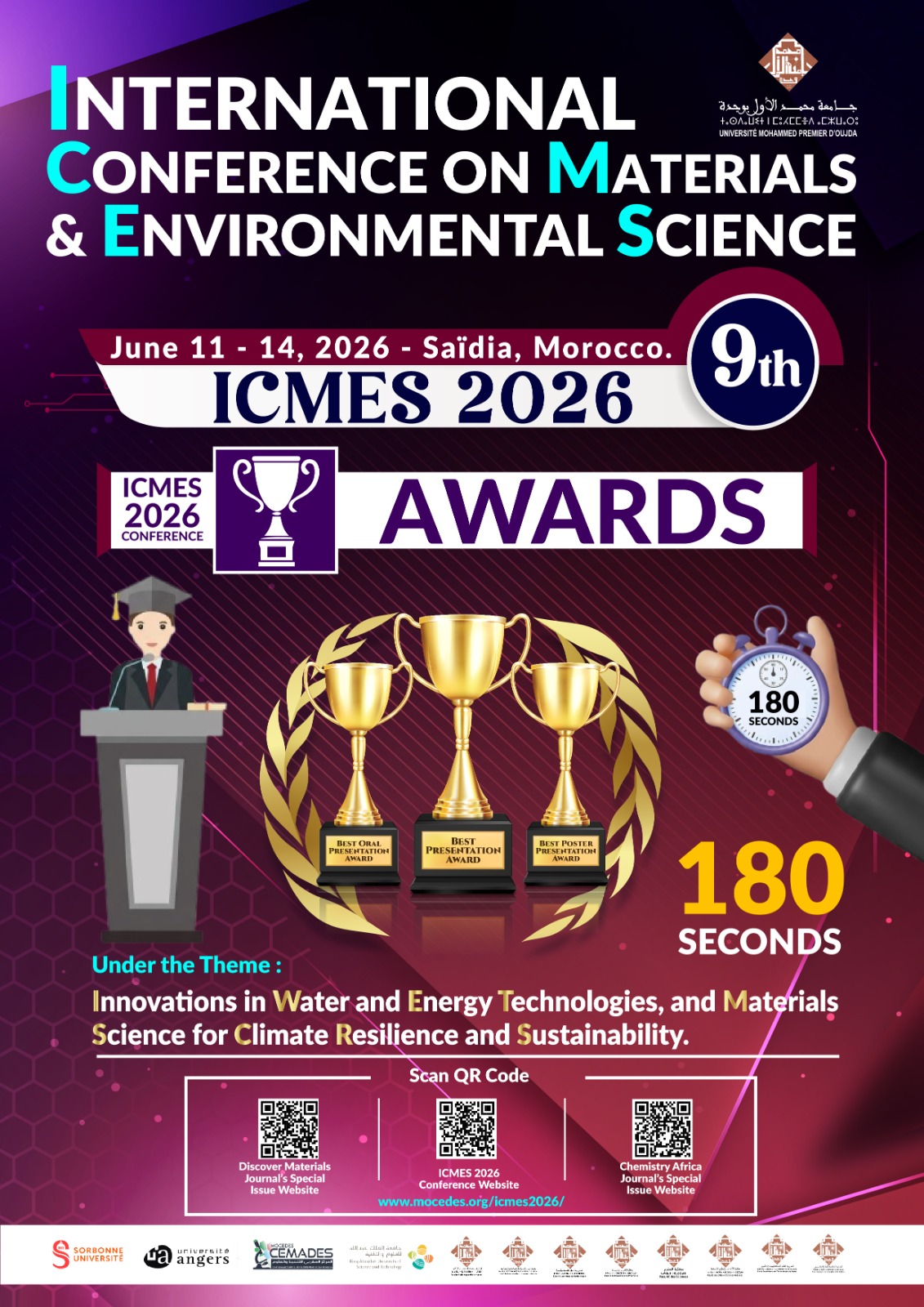
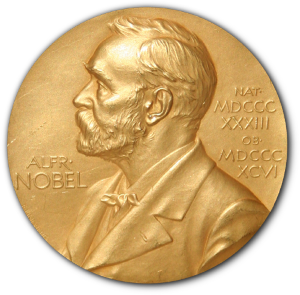
To recognize and encourage outstanding scientific contributions, Best Oral Presentation and Best Poster Awards will be organized for each technical session. These awards aim to acknowledge excellence in research quality, originality, clarity of presentation, and overall impact.

Award Image

DESCRIPTION

The conference will feature several technical sessions organized around different thematic areas. Best Presentation Awards will be granted to the oral and poster presentations selected as the most outstanding in each session. These awards aim to recognize and reward presenters for the additional effort required to prepare high-quality, top-caliber presentations. Through this initiative, the conference seeks to promote excellence in scientific communication and to encourage an even higher standard of presentation across all sessions.

The best presenter in each session will be selected based on several criteria, including the scientific quality and technical content of the presentation, clarity and effectiveness of the presentation style, adherence to allocated time, and the level of interaction and engagement with the audience.

EVALUATION CRITERIA FOR ORAL PRESENTATIONS

Each presentation will be evaluated independently by session chairs. The final score will be calculated as the average of the marks awarded by the session chairs. Based on this final score, the best presentation from each oral session will be selected. The evaluation will be conducted according to the eight criteria outlined below, which are considered in determining eligibility for this award :

▪ Applicability ▪ Originality ▪ Significance ▪ Quality of English Delivery ▪ Time Management ▪ Importance of the Work ▪ Novelty of the Work ▪ Presenter’s Ability to Clearly Explain the Work …

EVALUATION CRITERIA FOR POSTER PRESENTATIONS

Each poster presentation will be evaluated by a session chairs based on the criteria listed below. The presentation receiving the highest score in each poster session will be selected for the Best Poster Presentation Award :

▪ Depth of Content ▪ Quality of the Introduction and Abstract ▪ Content Knowledge and Organization ▪ Poster Design and Overall Visual Appeal ▪ Verbal Interaction with the Audience ▪ Quality of English Delivery …

All presenters are required to attend the Official Opening Ceremony and the Closing Ceremony in person, as the award recipients will be announced during the award ceremony.

On the first day, five Best Oral Presentation awards will be given, one for each of the five sessions. During the Official Opening Ceremony, these five recipients will receive a trophy and a certificate, and will have the opportunity to present their work in 180 seconds before an international jury. Among these five, the best presentation will be awarded a special prize : a LAPTOP. On the same day, two trophies will also be presented to the recipients of the Best Poster Awards.

On the second day, ten Best Oral Presentation awards will be given, one for each of the ten sessions. During the Closing Ceremony, these ten recipients will receive a trophy and a certificate, and will present their work in 180 seconds before an international jury. Among these ten, the best presentation will be awarded a LAPTOP.

Very warm welcome to 9th ICMES 2026 in Saïdia!

KEY DATES


  • March 22, 2026
    Abstract

    Submission Deadline

  • March 30, 2026
    Abstract

    Notification of Acceptance

  • April 12, 2026
    ICMES

    Registration Deadline

  • June 11-14, 2026
    ICMES

    Conference Dates

Registration

NATIONAL PARTICIPANTS: STUDENTS and ACADEMICS

REGISTRATION BEFORE APRIL 12, 2026
NATIONAL REGISTRATION FEES INCLUDES
PhD Student2000 MADRegistration = Conference Kit + 2 nights all-inclusive in a 5-star hotel
Double Room (2 adults / with ICMES participant)
  • Arrival date : Friday, June 12, 2026
  • Date of departure : Sunday, June 14, 2026
Academic2500 MADRegistration = Conference Kit + 2 nights all-inclusive in a 5-star hotel
Single Room
  • Arrival date : Friday, June 12, 2026
  • Date of departure : Sunday, June 14, 2026

INTERNATIONAL PARTICIPANTS: STUDENTS and ACADEMICS

REGISTRATION BEFORE APRIL 12, 2026
INTERNATIONAL REGISTRATION FEES INCLUDES
PhD Student250 EurosRegistration = Conference Kit + 2 nights all-inclusive in a 5-star hotel
Single Room
  • Arrival date : Friday, June 12, 2026
  • Date of departure : Sunday, June 14, 2026
Academic300 EurosRegistration = Conference Kit + 2 nights all-inclusive in a 5-star hotel
Single Room
  • Arrival date : Friday, June 12, 2026
  • Date of departure : Sunday, June 14, 2026
Academic380 EurosRegistration = Conference Kit + 3 nights all-inclusive in a 5-star hotel
Single Room
  • Arrival date : Thursday, June 11, 2026
  • Date of departure : Sunday, June 14, 2026
Academic480 EurosRegistration = Conference Kit + 4 nights all-inclusive in a 5-star hotel
Single Room
  • Arrival date : Wednesday, June 10, 2026
  • Date of departure : Sunday, June 14, 2026
or
  • Arrival date : Thursday, June 11, 2026
  • Date of departure : Monday, June 15, 2026

Important:


The registration fees cover accommodation in a 5-star hotel, according to the table above. They also include these elements :

- Certificate of Presentation/ Participation;
- Hard Copy of the Conference Program Guide;
- Electronic Copy of the Conference Program Guide;
- Electronic Copy of the Abstracts book in PDF;
- Access to all Sessions (oral and poster);
- Attendance at all Scientific Sessions Speakers of ICMES2025;
- Conference Kit (Pen, Notepad, Badge, Bag, Program and others);
- Coffee breaks (all days of the conference) : all inclusive;
- Lunches (all days of the conference) : all inclusive;
- Best Presenter Award for each session (Certificate + trophy for each winner, more than 15 trophies in total);
- Best Oral Award – 180s (Certificate + laptop for the winner).

Please check your status in the table above before making the payment (PhD students, academics, or national and international participants). Please note that registration fees paid are non-refundable if you are unable to participate in the conference.

Notes :

  • For PhD Student, please send us a copy of the student card
  • Please put your Abstract ID Number in your bank transfer receipt and send it by email to: icmes2026saidia@gmail.com

Venue

The conference will be held in Hotel Radisson Blu Resort Saidia Beach (5-star Hotel - All Inclusive) in Saïdia, Morocco.
Please find the link of the hotel: CLICK

Here are some details about transport in Saïdia:

  • Two airports are available : Oujda Angads Airport (50 km) and Nador El Aroui Airport (80 km);
  • Taxi fees between Oujda Angads Airport and the Hotel in Saïdia are 300 dirhams (30 euros);
  • The distance form Oujda Angads Airport to the Hotel in Saïdia is 50 Km;
  • The distance form Nador El Aroui Airport to the Hotel in Saïdia is 80 Km;
  • The nearest train station is in Oujda city, 60 km from Saïdia.
  • The grand taxi station is located in the center of Oujda. The fare is 50 dirhams (5 euros) per person, and the taxi carries up to 6 passengers. It is 60 km from Saïdia (about 1 hour).

Previous Videos